Thom Yorke’s Radiohead songs collide with Shakespeare in ‘Hamlet Hail to the Thief’
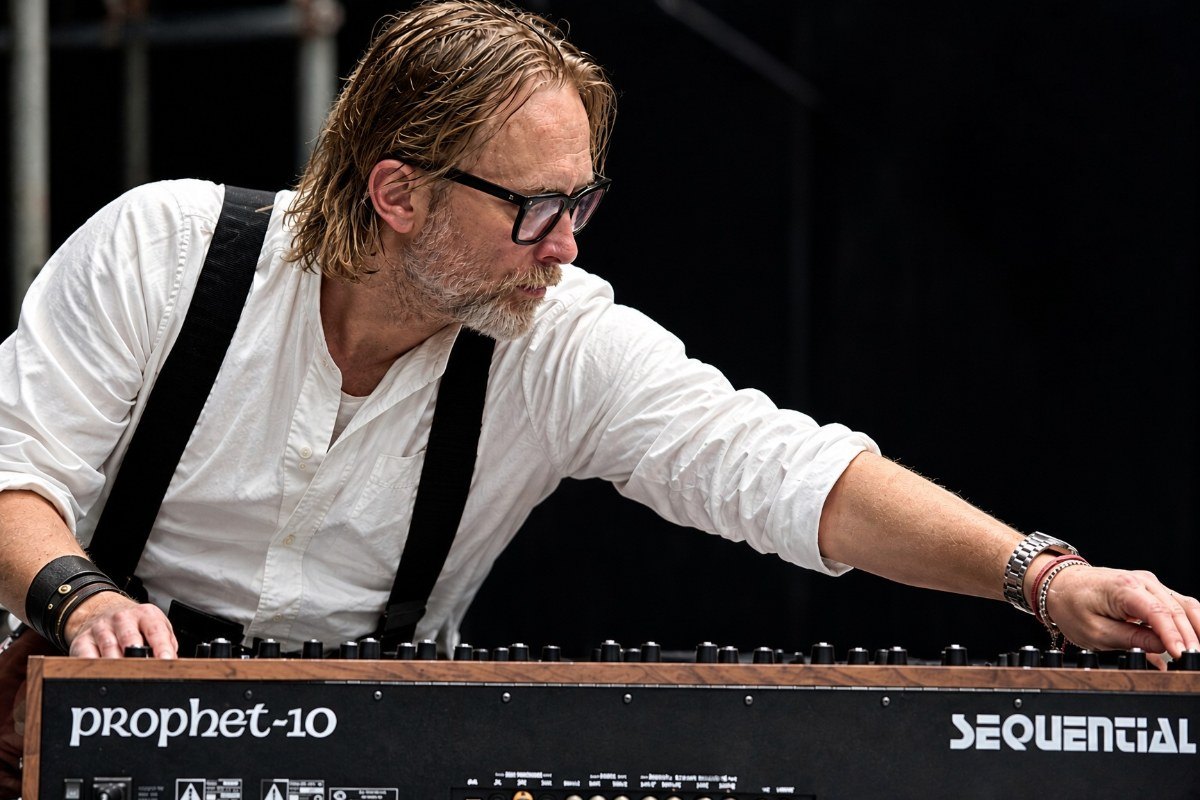
The Radiohead frontman initially thought the idea was close to sacrilege. Now, he’s helping turn Hail to the Thief into a fractured, unsettling new take on Shakespeare’s tragedy, as the production prepares for its London run.
Thom Yorke has never been particularly keen on the idea of putting music to Shakespeare. So when the prospect of reworking Radiohead’s Hail to the Thief for a new production of Hamlet first came up, his reaction was less than enthusiastic.
He’s since had a change of heart. “I’m always up for a little bit of sacrilege,” he has said of the project, which brings one of Radiohead’s most politically charged albums into conversation with one of the most enduring works in English literature.
Developed with the Royal Shakespeare Company and Factory International, Hamlet Hail to the Thief brings together Yorke, co-directors Christine Jones and Steven Hoggett, and choreographer Jess Williams for an unconventional take on Shakespeare’s tragedy.
The connection between the two works goes back more than two decades. In 2003, Jones was at Madison Square Garden watching Radiohead perform material from Hail to the Thief. Months later, while working on a production of Hamlet, she found herself returning to the album. The similarities between the two began to feel too compelling to ignore.
Both, she recognised, were concerned with distrust, paranoia, political deception and the difficulty of holding on to a moral compass in a compromised world. There was also something more intimate at work: the vulnerability beneath the anger, and the moments of tenderness that emerge amid the darkness.
Jones began imagining a production in which the two could exist alongside each other, neither one simply serving the other.
Breaking Radiohead apart
For Yorke, the idea took some getting used to. He had regarded Shakespeare’s work as something almost untouchable, and had never thought of Radiohead’s music as a natural fit for the stage. But once Jones put the proposal to him, he found himself unable to shake it.
He also discovered that Shakespeare had worked with composers of his own day, using music as a structural part of his plays rather than as an ornamental extra. The more Yorke considered the idea, the less far-fetched it seemed.
The challenge was figuring out how to make it work.
Hail to the Thief, released in 2003, was never written as a companion piece to Hamlet. Nor would simply running through its tracklist, playing each song in full, do justice to Shakespeare’s story. Instead, Yorke has taken the album apart, cutting and rearranging its constituent pieces to create something new.
The process has given him an opportunity to revisit a record he has previously described as one that got away from him. Made relatively quickly, Hail to the Thief captured a particular moment of political unease, but its themes have proved difficult to leave behind.
The new score is less a collection of familiar songs than a series of fragments, reassembled around the play. Music and text are intended to push against one another, sometimes unsettling the audience rather than reinforcing what is happening on stage.
That distinction matters to Yorke. He has been keen to avoid the music becoming a conventional emotional guide, following the action and telling the audience how to feel. The aim is to let the songs and Shakespeare’s language challenge each other, creating tension rather than easy harmony.
Bodies, paranoia and the space between words
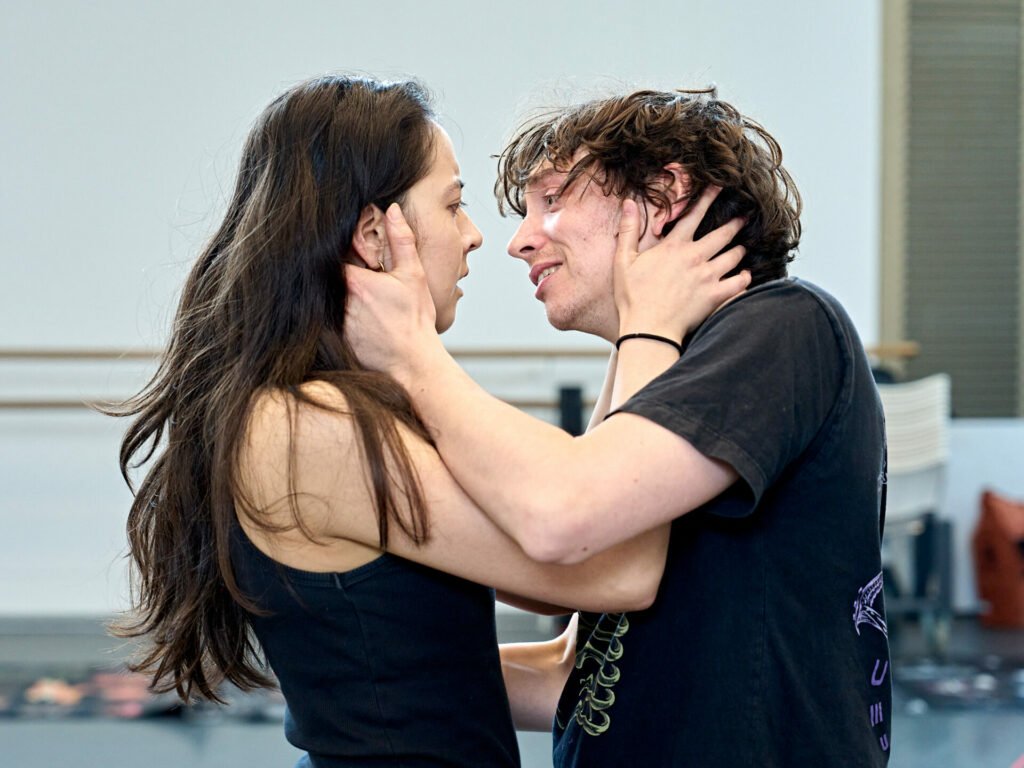
Hoggett, whose work includes American Idiot, Let the Right One In and Harry Potter and the Cursed Child, brings a physical approach to the production. Rather than asking actors to translate Shakespeare’s speeches into literal gestures, he and Williams have developed movement through a series of practical exercises, exploring what it means to conceal something, pursue someone in anger or behave differently from how one feels.
The movement has been shaped around the emotional undercurrents of the play, with the performers’ bodies often revealing what the characters would rather keep hidden.
Jones has drawn inspiration from the contorted figures in the work of artists Robert Longo and Egon Schiele. Their images of bodies caught in states of tension and distortion offer a visual reference for a production in which movement, music and language are constantly pulling against each other.
The set follows a similarly uneasy logic. Part recording studio, part sound-testing chamber and part interrogation room, it creates an atmosphere in which surveillance and uncertainty are never far from the surface.
There is no attempt to pin the story to a specific political moment, however. Although the title Hail to the Thief was taken from language associated with protests against George W. Bush, Yorke is wary of allowing the production to become locked into a single political interpretation.
Instead, the creative team wants the audience to draw its own conclusions. The questions at the heart of the show are broader than any one administration or news cycle: how do we know whom to trust, how do we understand the world around us, and where do we find our bearings when the people in power appear determined to mislead us?
A different way into Hail to the Thief
The production is the result of a creative idea that has been developing for more than 20 years. What began as Jones’s intuition about two seemingly unrelated works has become an ambitious attempt to find a shared language between theatre and alternative rock.
There were early concerns about whether anyone other than Yorke could convincingly inhabit Radiohead’s music. For Hoggett, those doubts began to fall away once the team started working together in the rehearsal room. The material proved more open to reinterpretation than he had expected.
That willingness to experiment is central to the production. Rather than treating either Shakespeare or Radiohead as untouchable, the team has taken both apart to see what might emerge when their familiar structures are disrupted.
The result is not simply Hamlet with a Radiohead soundtrack, nor a theatrical performance built around an album. It is an attempt to find new meaning in both, using their shared anxieties as a starting point rather than a conclusion.
Following its earlier performances in Manchester and Stratford-upon-Avon, Hamlet Hail to the Thief arrives at the Barbican Theatre in London from 31 October 2026 to 23 January 2027. Samuel Blenkin stars as Hamlet, alongside Ami Tredrea as Ophelia, Paul Hilton as Claudius and Claudia Harrison as Gertrude.
For Yorke, the move into theatre represents a departure from the familiar structures of making and performing music. For audiences, it offers a chance to hear Hail to the Thief in a new context, stripped of its original sequence and made to confront Shakespeare’s language on its own terms.
More than two decades after the album’s release, its questions about power, mistrust and political deception remain unresolved. The point of this production is not to offer answers, but to see what happens when those questions are put back on stage.